top of page


location
Amstelcampus, Amsterdam
client
Amsterdam University of
Applied Sciences
photography
Thea van den Heuvel (DAPh)
completion
2015
design of new university building
The new Wibauthuis building provides a dynamic working and learning environment for Amsterdam University of Applied Sciences, giving shape to the ambitions of the Amstel Campus. The campus is based on the idea that education should be more closely aligned with social development, partly through a return from the periphery to the heart of the city.
The exchange of knowledge and experience, and with it the cross-pollination of different disciplines, characterizes the campus design. This means that exchange takes place not only within the walls of classrooms, but especially outside them. To make this possible, a multifunctional working environment with a wide variety of facilities has been designed. The high quality of the physical environment encourages students and teachers to spend as much time as possible on campus. This increases the chances of fertile ground for new talent and new initiatives.
low threshold
The connection to the surrounding city shapes the role that the Amstel Campus wants to play in society. On the ground floor, a high degree of transparency provides a view of the interior, designed as a continuation of the public space outside. Information desks, kiosks, and seating elements are objects that have been placed in the space as street furniture. The restaurant is a flexible space that offers open and sheltered areas for everyday use, where people can also work. The layout can be easily adjusted, for example to make room for large-scale events.
design
In the design, form and materials are a natural result of the chosen concept and the way in which the quality of the architecture is optimally utilized. It creates order but also offers freedom to users. For the Amsterdam University of Applied Sciences, it was important that the interior was sustainable. Not only in terms of the use of materials, but also in terms of durability, which has been achieved in the design.
new forms of design
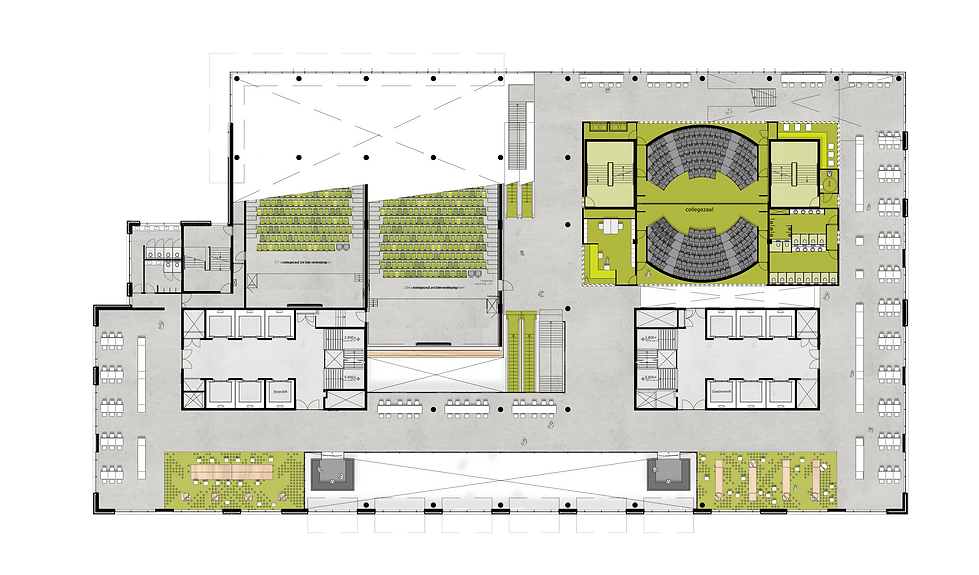
Education at the Amstel Campus focuses on the increasing complexity of society. The interior design therefore also includes facilities that enable new forms of education. An example of this in the Wibauthuis is the “Arena,” where two small lecture halls with movable walls can be joined together. The resulting layout offers possibilities for an interactive setting, for example for discussion sessions and interviews.
The working environment for students and lecturers has also been designed with the idea of greater interaction and creating opportunities for new ideas. Open spaces, enclosed project rooms, and sheltered areas for individual work alternate. The different levels in the building have a spatial organization that creates a dynamic yet calm atmosphere.
bottom of page